
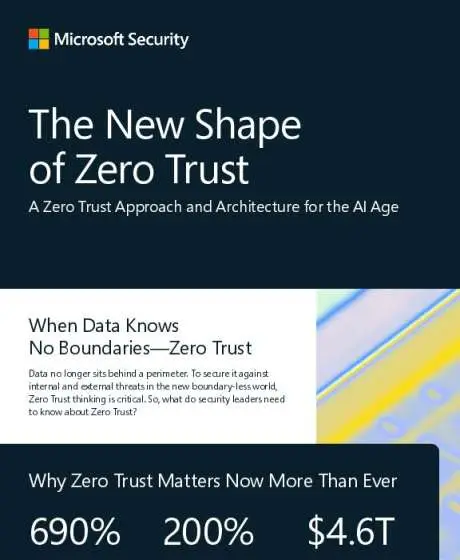
New Shape of Zero Trust. Security no longer starts and ends at the network edge. This infographic outlines how a modern Zero Trust approach replaces perimeter-based thinking with continuous verification, least-privileged access, and an assume breach mindset. View the infographic to learn the basics of Zero Trust.
Check out our Cybersecurity page!
View: The New Shape of Zero Trust
Zero Trust: A Modern Security Framework
Zero Trust is a cybersecurity strategy built on a simple principle: “Never trust, always verify.” Unlike traditional security models that assume users and devices inside a corporate network are trustworthy, Zero Trust assumes that every access request—whether from inside or outside the network—must be authenticated, authorized, and continuously validated.
Why Zero Trust Matters
Today’s organizations operate in a world where employees work remotely, applications run in the cloud, and users access company resources from multiple devices. At the same time, cyberattacks such as ransomware, phishing, credential theft, and insider threats continue to increase.
Traditional perimeter-based security (“castle and moat”) is no longer sufficient because attackers who breach the network often move freely once inside. Zero Trust limits that movement by requiring verification at every step.
Zero Trust in Practice
Consider an employee working remotely who wants to access a customer database:
- The employee signs in using MFA.
- The identity platform verifies the user’s credentials.
- The device is checked for compliance (patches, encryption, endpoint protection).
- A conditional access policy evaluates risk factors such as location and device posture.
- If approved, the user receives access only to the specific database needed.
- User activity is monitored throughout the session.
- If unusual behavior is detected—such as large, unexpected data downloads—access can be restricted, additional authentication requested, or the session terminated.
Best Practices
Organizations implementing Zero Trust should:
- Enforce MFA for all users.
- Apply least-privilege access across systems and applications.
- Segment networks and critical workloads.
- Continuously monitor users, devices, and applications.
- Secure endpoints with modern endpoint detection and response (EDR) solutions.
- Encrypt sensitive data both in transit and at rest.
- Regularly review access permissions and remove unused accounts.
- Automate security policy enforcement where possible.
- Maintain comprehensive logging and incident response capabilities.
- Train employees to recognize phishing and other social engineering attacks.
Conclusion
Zero Trust is a comprehensive security model that shifts the focus from protecting a network perimeter to protecting identities, devices, applications, and data. By continuously verifying every access request, limiting privileges, and assuming that breaches can occur, organizations can significantly reduce their exposure to modern cyber threats while enabling secure access for users across on-premises, cloud, and remote environments.